
Progressive Disclosure for Skills: On-Demand Loading in Pi and DeepSeek Harness
Two Questions
An agent can have many skills installed, while any given task usually needs only a few. Loading every procedure and reference into context at startup would burden every task with irrelevant material. Progressive disclosure lets the model first learn which capabilities are available, then load their details as the task requires.
This raises two questions: how do the layers of a skill enter context? And if the model has only read its description, how does it know to read SKILL.md next?
The overall sequence is: discover skills → provide a catalog and loading rules → assess the task match → call a tool → add the instructions to context. Pi and DeepSeek Harness both follow this sequence, but differ in where the catalog appears, how paths are exposed, and which tool loads the instructions.
Pi: Loading a Skill with read
Discover Skills and Build a Catalog
The host first scans skill directories, such as a project’s .agents/skills/. The actual search paths also depend on the harness configuration; this example is not the only entry point.
After discovering skills, Pi organizes their name, description, and location into a catalog and adds it to the system prompt. These fields answer three questions: what is the skill called, which tasks does it serve, and where are its instructions?
The following illustrates the catalog structure:
<available_skills>
  <skill>
    <name>translate</name>
    <description>Translate text using the project's terminology and language conventions</description>
    <location>/project/.agents/skills/translate/SKILL.md</location>
  </skill>
</available_skills>
The model can now see the skill’s purpose and location, but it has not yet received the translation procedure. The description supports selection; the operational steps remain in the body.
Here, “load metadata first” means putting metadata into model context first. To parse frontmatter, the host may already have read the entire file from disk. Pi’s discovery logic does exactly that, reading the full file before extracting the catalog fields. A file being read by the host and its contents being visible to the model are two different events.
Loading Rules Connect the Description to a Tool
A catalog alone does not explain how to proceed. Pi also provides an explicit rule: when a task matches a skill’s description, use the read tool to read its file.
The rule has three parts: the trigger is a task matching the description; the action is a read call; the target is the file specified by location. The information needed to move on to the instructions therefore comes from the catalog, the trigger rule, and the available tool together.
A call follows this schematic sequence:
LLM determines that the task needs translate
    -> read({ path: "/project/.agents/skills/translate/SKILL.md" })
Host reads the file
    -> adds its contents to context as a tool result
LLM uses the instructions to decide the next action
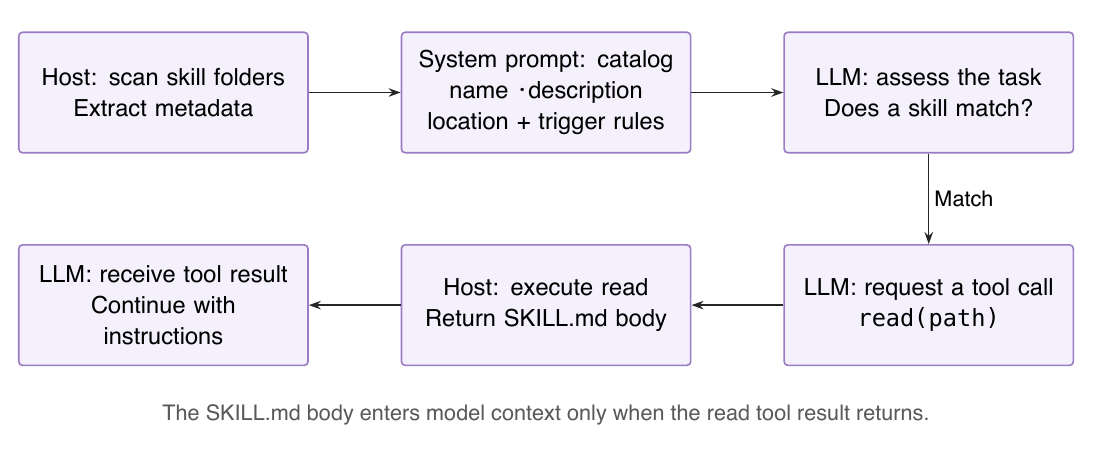
The model judges relevance and generates the tool call. The host reads the file and returns the result. A description does not execute a load, and a file does not become model input merely because it exists on disk.
Automatic selection can still miss a relevant skill or choose the wrong one. Descriptions should clearly state the applicable tasks and triggers so that the model can distinguish neighboring capabilities. Test requests that should trigger a skill, requests that should not, and requests that are easy to confuse, then refine the boundaries.
Three Layers, Three Loading Moments
The first layer is the skill catalog, primarily names and descriptions. The model learns which capabilities are candidates and decides whether the current task needs them.
The second layer is the body of SKILL.md, which provides procedures, constraints, and completion criteria. It loads after the task matches, giving the model specific instructions for carrying out this kind of work.
The third layer is material referenced by the instructions, such as detailed specifications, template notes, or supplementary guides in references/. The model reads these when it reaches the relevant step and needs the detail.
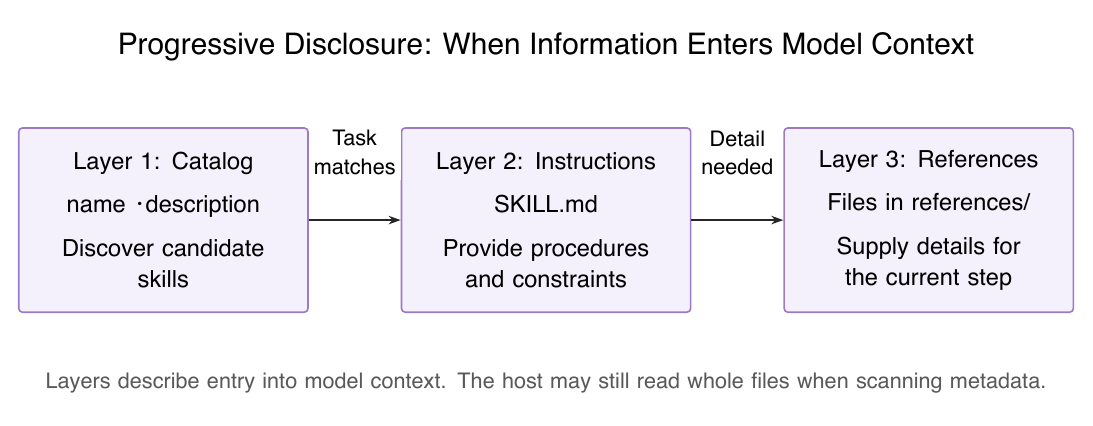
For example, if the instructions reference references/translate-guide.md, reading SKILL.md does not also load that guide. Its relative path must first be resolved against the skill directory, and an appropriate tool must retrieve the contents. The instructions should explain when the guide is needed; otherwise, the material has merely been moved to another file.
Progressive disclosure therefore requires both content boundaries and conditions for entering the next layer. The catalog supports selection, the instructions support execution, and the references supply details needed at the current step. Whether to load more depends on the task.
The layers must also ensure that necessary information reaches the model. Core constraints that apply whenever the skill is used should remain in the instructions. Details for a particular branch can go in references, with explicit reading conditions. If a critical restriction is buried in a reference file with no trigger in the instructions, the model may act before it ever encounters the restriction.
DeepSeek Harness: Loading by Name with skill
The Catalog Enters Context as a user-role Message
DeepSeek Harness (DSH) also discovers skills first, but the model-visible catalog contains only name and description. The host generates this catalog and adds it to the conversation as a user-role message.
This message is not an extra request manually sent by the user. It is a skill notice assembled by the harness for the model. An explicit rule accompanies the catalog: if the user names a skill, or the task clearly matches its description, call the skill tool to load its full instructions before performing the task.
The system prompt is part of context, and so are user-role messages. The comparison concerns the role under which the catalog enters model input. Even if the message body uses a <system-reminder> tag, the actual role is still determined by the message’s role field.
Pass the Name to the Tool; Let the Host Resolve the Path
Pi uses a general file-reading interface, so it must give the model the file path. DSH provides a dedicated skill tool; the model only needs to pass the exact name from the catalog:
skill({ name: "translate" })
On receiving the call, the host looks up the registered skill by name and loads its instructions through the corresponding provider. The host handles the mapping from a name to a local file or other resource; the initial catalog need not expose the path to the model.
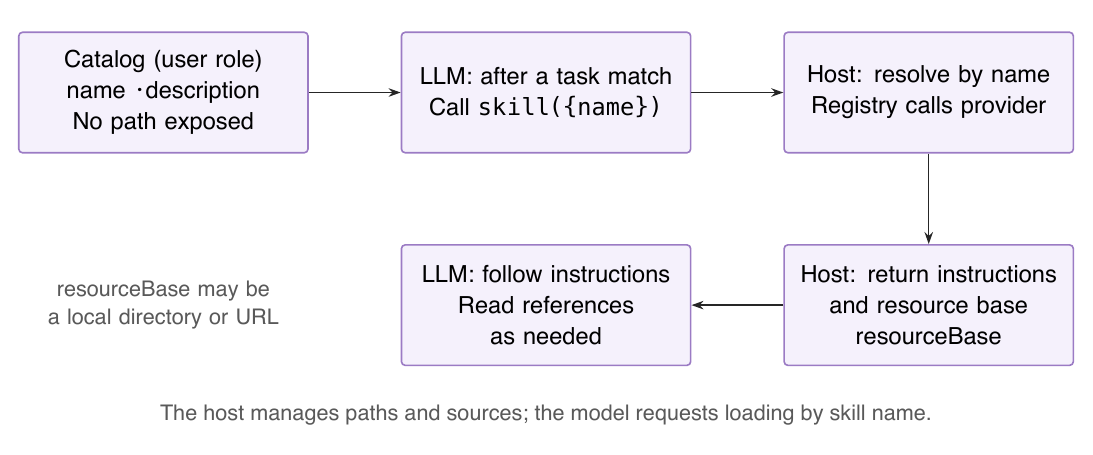
The result must give the model both the instructions and the location information needed to access references. In the DSH implementation examined here, a tool execution result contains the body in content and may also include a resource base in resourceBase. The host turns these into model-readable instructions and resource hints. For a filesystem skill, this base is its directory.
Thus, “the catalog has no location” only means that the path is absent from the initial candidate list. After loading the instructions, the model may still need the resource base to resolve relative references correctly. It no longer has to supply a file path in its loading request; the host resolves the name to the resource.
skill({name}) is a loading request. Once the host executes it successfully and returns the instructions and resource hints, the model can use them on the next step. This does not automatically load the entire skill folder or run every script it contains. Nor does adding the body to context turn it into a system message.
How the Two Implementations Differ
| Dimension | Pi’s read Path | DSH’s skill Path |
|---|---|---|
| Where the catalog appears | System prompt | User-role conversation message |
| Model-visible catalog fields | name, description, location | name, description |
| Model’s loading request | read(path) | skill(name) |
| Information used to locate instructions | File path supplied by the catalog | Source looked up by name in the host |
The table compares Pi’s general read loading path with DSH’s dedicated skill path. The Pi code is pinned to ce950d78, and DSH to ddefc45f; the fields and interfaces refer to those implementations.
Where the catalog appears and how the tool locates the instructions are separate design dimensions. A user-role message can carry paths, and a system prompt can ask the model to call a tool that loads by name. Pi exposing location and DSH omitting the path from its catalog directly reflect the parameters their loading interfaces require.
General-purpose read reuses existing file-reading capabilities and makes the process direct. Dedicated skill consolidates name lookup, source resolution, and result formatting behind one interface. The former requires the model to supply a path in its call; the latter leaves the name-to-source mapping to the host. The choice depends on how the harness organizes tools and resources.
Automatic Selection and Explicit Loading
The preceding flow relies on the model to judge whether a task matches a description. The host can also provide an explicit loading entry point so that users can select a skill directly.
In the Pi implementation examined here, entering /skill:translate makes the host read the instructions directly and expand them into the user message. The model need not first decide whether to call read. DSH likewise supports commands such as /translate for skills that allow user invocation, with the host loading the instructions.
The natural-language request “please use translate” may take a different path from a loading command recognized by the host. The former can trigger a model tool call; the latter can let the host load the skill directly. Either way, reading references and running scripts still require subsequent tool calls, and execution depends on tool and environment permissions.
Catalog Cost and Update Boundaries
Progressive disclosure reduces the upfront loading of irrelevant instructions, but the catalog itself still occupies context. More model-visible skills and longer descriptions mean a larger candidate list. Descriptions should be sufficient to distinguish tasks, with operational procedures left to the instructions. Third-layer references should be read only when a relevant step requires them.
Updates also require a distinction between catalog and instructions. In the DSH implementation examined here, later model steps check the catalog. When model-visible names, descriptions, or membership change, the host appends a complete replacement catalog to the conversation and tells the model to use it. The old catalog remains in the history.
Changing only the instructions may leave the catalog unchanged. This implementation reads the current body when skill loads it again, but does not automatically rewrite the earlier tool result. “The file has been updated” and “current context contains the new instructions” are therefore different states. When new rules must apply, reload explicitly so that subsequent steps know which version to use. Actions already taken require a separate check.
Summary
(1) Progressive disclosure controls when content enters model context: first the catalog, then the instructions, and finally references as needed. The host reading a file and the model receiving its contents must be understood separately.
(2) Moving from description to instructions requires explicit loading rules and an executable tool interface. Users can also select a skill through an explicit entry point. The description guides selection; the loaded instructions guide execution.
(3) Pi and DSH demonstrate two implementations: a general read tool called by path, and a dedicated skill tool called by name. Both require clear content boundaries at each layer and explicit conditions for entering the next.